About
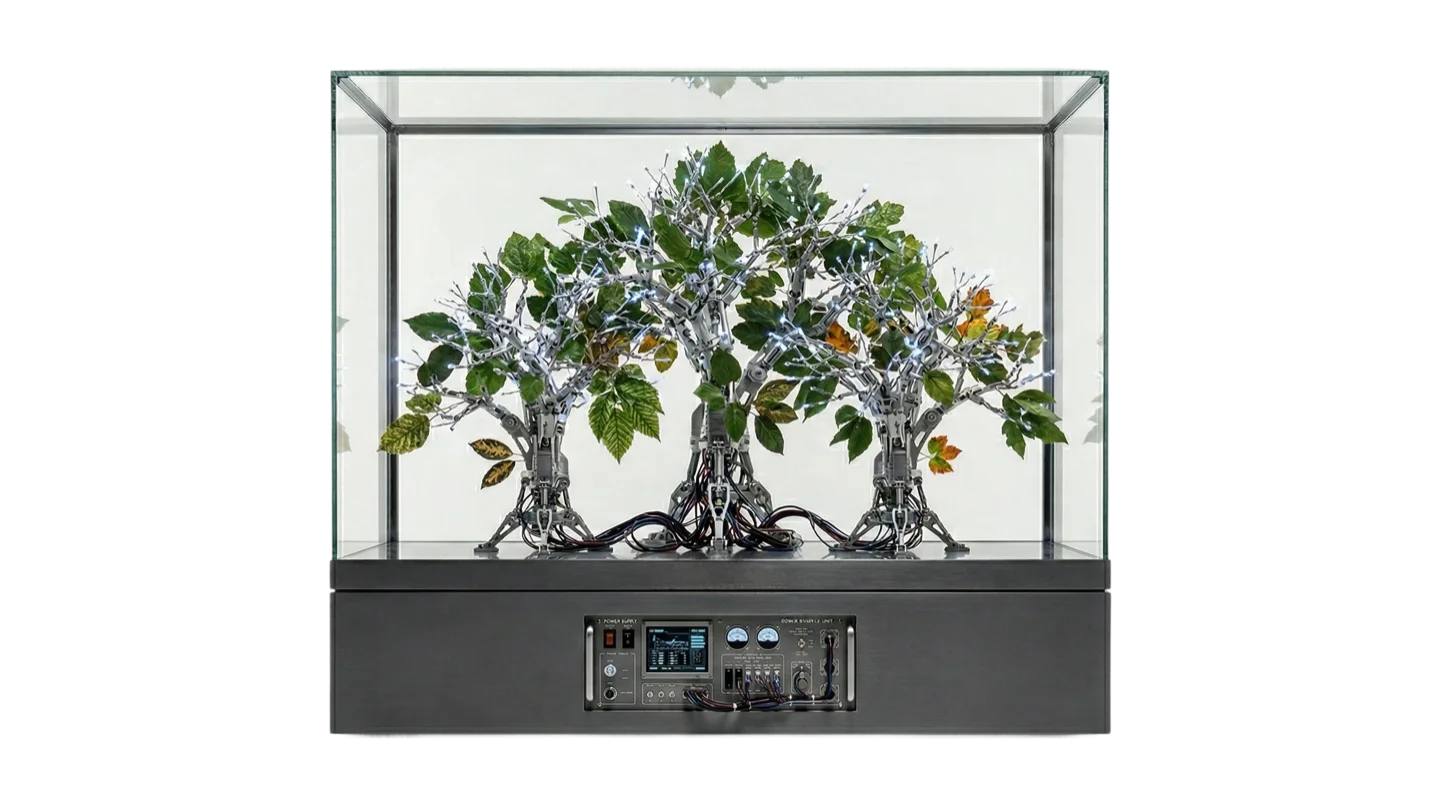
Alphabet of Planetary Repair is a speculative archive of a world kept alive by systems of intervention. It treats the alphabet not as a neutral tool of language, but as an engineering interface: each letter becomes a glyph of survival, a fragment of a future in which nature can no longer exist without machinery.
The project asks a difficult question: what does a landscape become when it is no longer self-sustaining, but continuously maintained by technological life support? In this sense, the work sits between image, taxonomy, and manifesto. It does not offer optimism as an aesthetic. Instead, it stages a cold, fragile, and unresolved vision of planetary repair — one in which every solution is also a sign of crisis.
The result is a visual language for an era of permanent emergency: monochrome, precise, and clinical; somewhere between scientific atlas, industrial manual, and damaged future archive. The project is not documentation, but a visual secession at the edge of collapse. Typography becomes the skeleton of civilization, reassembled through the tools of geo-engineering.
"I do not build monuments for nature. I build prostheses for a planet that has forgotten how to breathe on its own."
METHODOLOGY: The Anatomy of Repair
I. The Memorial of Biomass
Every letter is a relic. I begin with the resistant: dried wood, bleached bone structures, the cracked skin of the earth. This is organic memory breaking under the Anthropocene. In my glyphs, decay is not concealed — it becomes the foundation of hybrid existence.
II. The Aesthetics of Intervention
Where nature falls silent, technical prayer begins. I enclose the dying form in an exoskeleton of cold metal and sterile polymers.
The framework: a cage that supports while it imprisons.
The channels: tubes and conduits like artificial veins.
This symbiosis asks: if nature breathes only through machines, is it still nature — or already an artifact of fear?
III. Alchemy of Survival
Into each glyph's heart, I weave rescue mechanisms — a functional alchemy:
Mirrors that repel light as if the sun were an intruder.
Coal that preserves millennia in porous darkness.
Filters that wash CO₂ ghosts from the void.
Each material is geometry's desperate stand against entropy.
IV. The Monochrome Archive
Color is removed to mute hope's noise. What remains is pure texture: grey space's silence against machine complexity. This clinical gaze reveals my own hubris — repairing the world by turning it into a laboratory.
V. Research Foundation
The glyphs draw from climate engineering, carbon removal, cryosphere protection, ocean interventions, and infrastructural systems. Rather than literal illustration, the alphabet abstracts them into a speculative diagnostic system — visualizing technology's afterlife on a mechanized Earth.